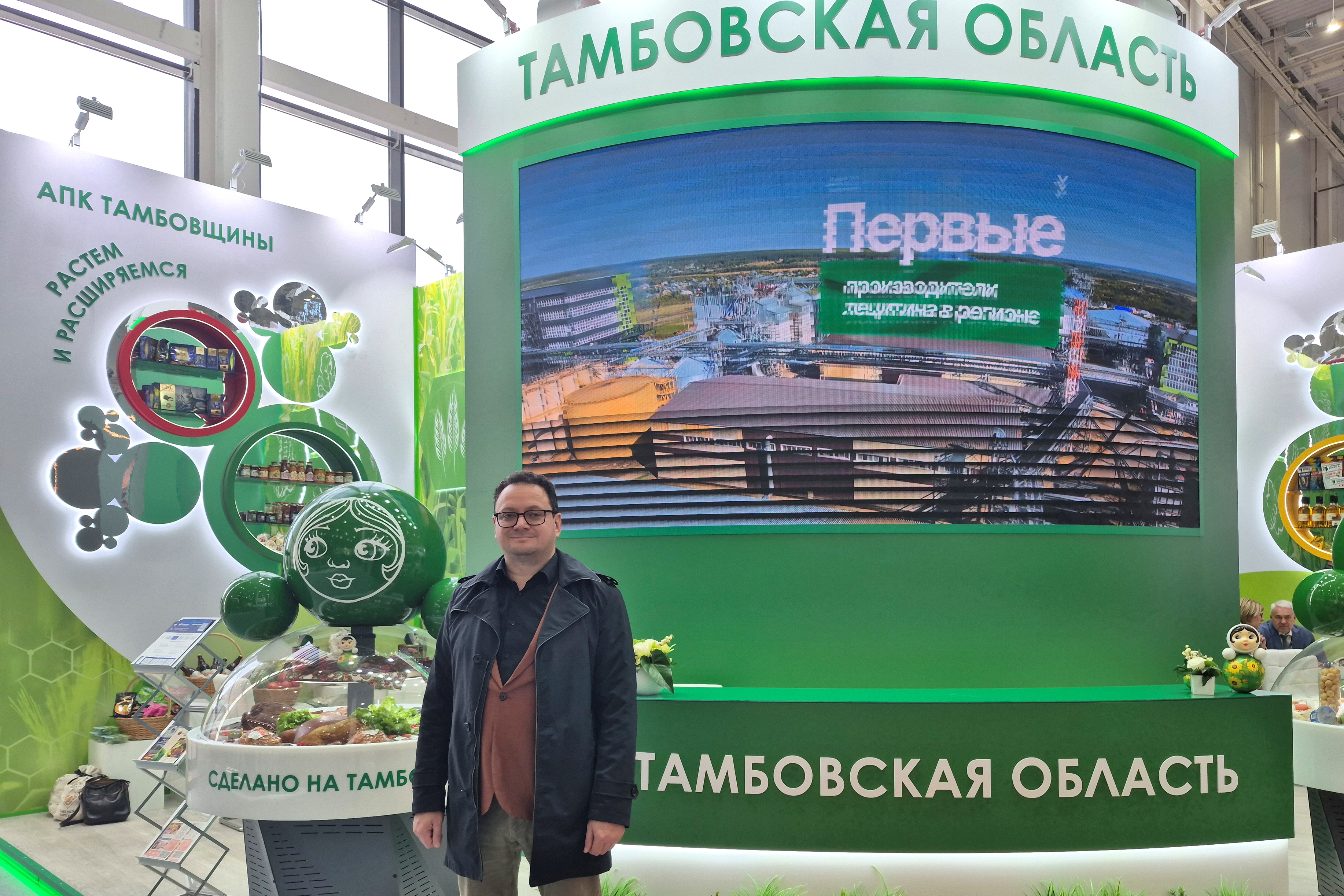
The 28th Russian Agro-Industrial Exhibition, "Golden Autumn 2026," took place in Moscow at the Timiryazev Center, an educational and exhibition complex. Alexander Gusev, Vice-Rector for Research at the G.R. Derzhavin Tambov State University, participated in the event.
The exhibition brought together government officials, business leaders, members of the scientific community, and agricultural producers from various regions across the country. It showcased regional achievements, including agricultural products, investment projects, and development programs, allowing participants to explore best practices and innovative solutions in the agricultural sector.
"Significant attention was devoted to modern agricultural machinery—ranging from specialized harvesters to robotic systems—which clearly demonstrates the growth in efficiency and labor productivity within the agricultural sector," noted Alexander Gusev, Vice-Rector for Research at Derzhavin University. "Along with other attendees, I had the opportunity to view a diverse range of pedigree livestock and poultry, as well as products and beverages from domestic producers. A distinct segment of the exhibition focused on solutions for agribusiness, covering digital platforms, logistics, and insurance."
The "Digitalization" zone, which featured IT solutions for process automation, drew particular interest. Farmers and enterprise managers were able to explore various tools designed to optimize their operations.
The business program included plenary sessions featuring representatives from the Government of the Russian Federation, as well as industry-specific conferences and expert sessions. Key topics addressed included innovation, the sustainable development of the agro-industrial complex, and successful regional practices. The central event—a plenary session titled "Navigator for the Russian Agro-Industrial Complex: Technologies for Effective Growth"—enabled participants to discuss pressing issues, the industry's development prospects, and innovative solutions with practical applications.
The exhibition program featured activities for the whole family, including the younger generation. The "New Agrarian Culture" track, for instance, offered quizzes, trivia games, VR tours, and masterclasses, all highlighting the relevance and potential of the agricultural sector. The "Gastronomic Autumn" festival included a farmers' market showcasing products from 32 agricultural enterprises, alongside culinary workshops led by professional chefs. The exhibition also hosted a celebratory concert in honor of the Day of Workers in Agriculture and the Processing Industry.
The Russian Ministry of Agriculture held industry-specific competitions to recognize top performers in the field. Notably, the Department of Crop Production organized a contest for "Achieving High Performance in Crop Production," which drew participation from agricultural producers, businesses, and various scientific and educational institutions. Winners were awarded medals and diplomas, and granted the right to feature the competition’s logo on their products—an initiative that encourages higher product quality and the overall advancement of the sector.
According to Alexander Gusev, such forums play a vital role in promoting agriculture and drawing attention to innovative solutions. They provide a platform for participants to exchange experience, knowledge, and best practices, while fostering new scientific and industrial partnerships.
Derzhavin Tambov State University places a strong emphasis on research and development in the field of agricultural technology. With support from the Russian Science Foundation, the university’s scientists have developed a prototype for a plant protection product based on copper oxide nanoparticles stabilized by polymer molecules. In field trials, the product demonstrated an efficacy level comparable to that of its foreign counterpart, while proving to be more environmentally friendly toward beneficial soil microflora. This and other developments by scientists at Derzhavin University contribute to building technological sovereignty in the field of advanced agricultural technologies.