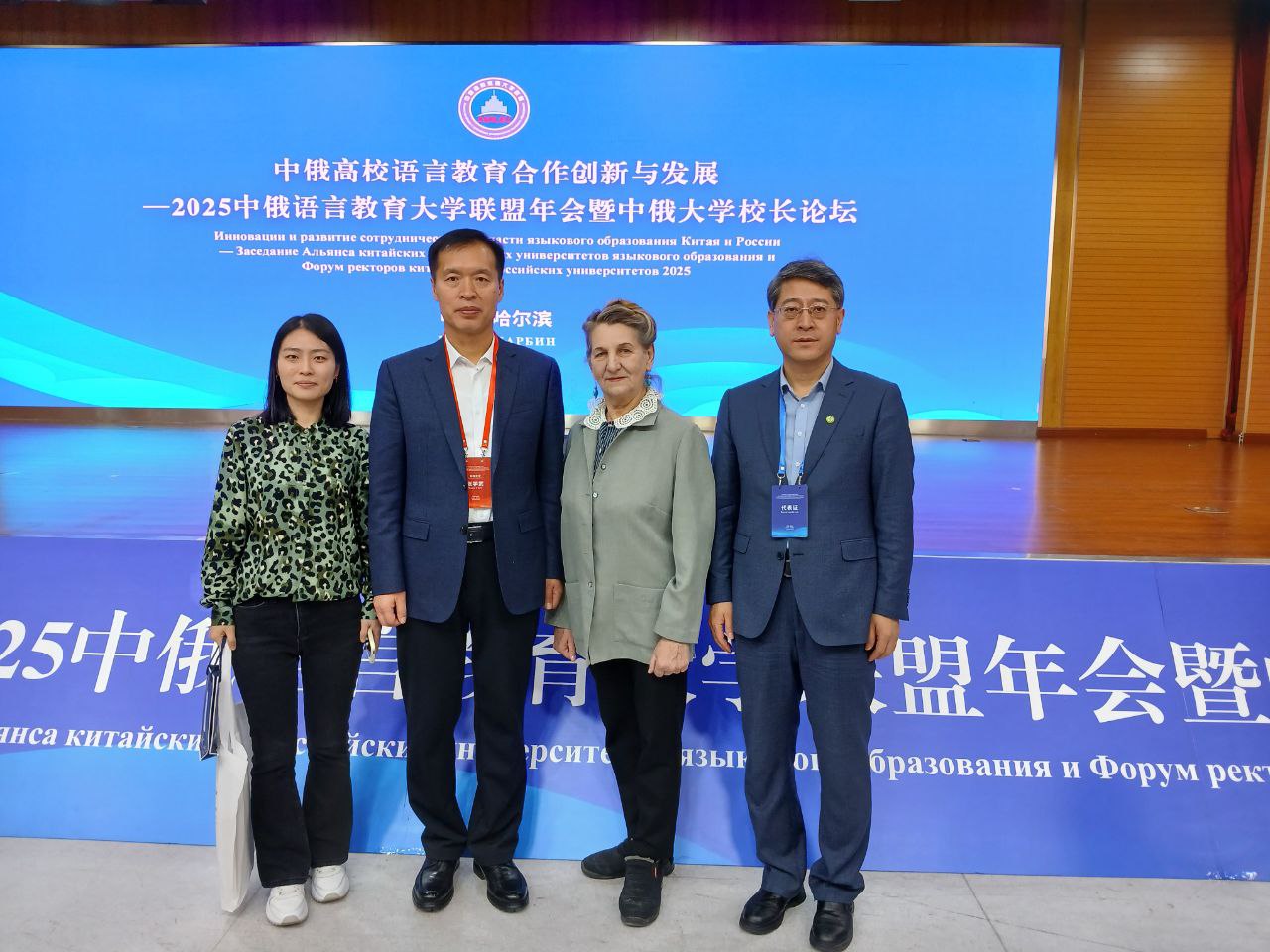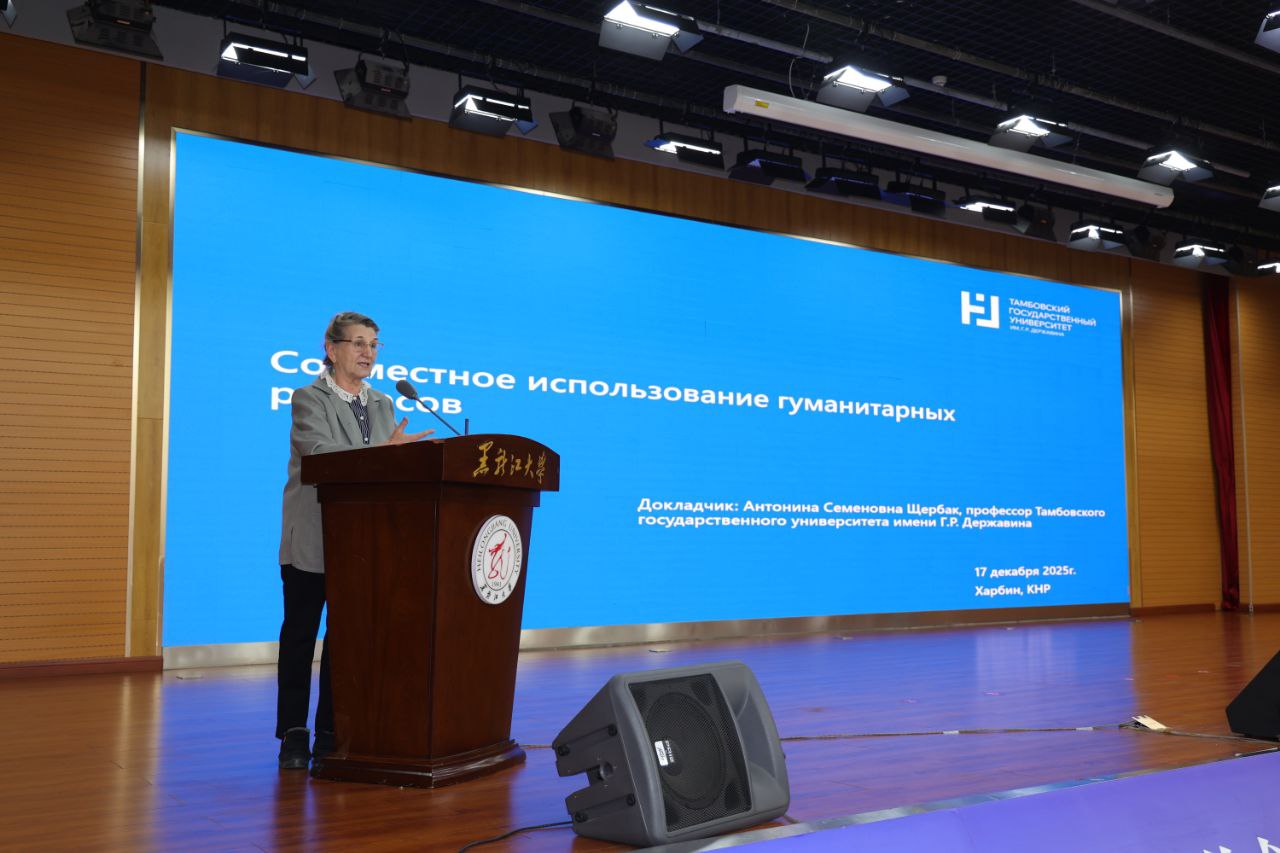
Representatives of Tambov State University named after G.R. Derzhavin took part in Chinese and Russian Universities Alliance Meeting offering language education, which was held at Heilongjiang University (Harbin, China). Derzhavin University was represented by Antonina Shcherbak, Professor of the Department of Russian Language, Russian, and Foreign Literature, and Guo Juanjuan, a member of the Department of International Relations.
The event, which brought together over 140 representatives from 40 leading universities in both countries, discussed the development of pragmatic bilateral cooperation in language education, science, and culture, as well as the expansion of humanitarian exchanges between the two countries.
Irina Kraeva, Rector of Moscow State Linguistic University, participated in the meeting entitled "Innovation and Development of China-Russia Cooperation in Language Education – 2025." The Alliance was initiated by MSLU and Heilongjiang University, one of China's leading humanities universities.
The meeting discussed innovative areas of language education, including cloud technologies. This topic is as promising as artificial intelligence. In October 2025, Heilongjiang University launched the "Sino-Russian International Cloud Classroom" educational project. Currently, Russian universities are actively developing "international cloud classes" as part of the digitalization of education and partnerships with Chinese universities.
Derzhavin University joined the Alliance of Chinese and Russian Universities for Language Education in 2024. The main goal of the alliance is to create a platform for Chinese-Russian cooperation in language education, humanitarian exchange, resource sharing, training highly qualified specialists, and promoting friendship and cooperation between China and Russia.
"Participation in the meeting of the Alliance of Chinese and Russian Universities for Language Education allowed us to appreciate Derzhavin University's contribution to strengthening Russian-Chinese cooperation and the unique rhythm of Chinese characters," noted Antonina Shcherbak, professor in the Department of Russian Language, Russian, and Foreign Literature. "This rhythm is driven by the desire to create a solid platform for collaboration with Chinese universities, the exchange of educational resources, and the enhancement of new formats in linguistic education at universities in Russia and China. This primarily involves improving the quality of training specialists in language education. The successful combination of fundamental and practical approaches to education makes it accessible and attractive to both sides."
At the forum, the representatives established contacts with of more than a dozen Chinese universities, including Heilongjiang University, Sichuan Foreign Studies University, Yanbian University, Northeastern University, Northeast Normal University, Inner Mongolia Normal University, and others. Our Chinese partners are interested in implementing student and faculty mobility programs, conducting thematic schools for students, and dual-degree programs.
"I've been studying Russian language, literature, and culture for many years. Language isn't just words, suffixes, prefixes, phonetics, and grammar. It's, first and foremost, a worldview—a worldview—and relationships between people. In today's world, learning foreign languages builds bridges of intercultural friendship and mutual understanding, a force that advances global cooperation on the world stage," said Guo Juanjuan, an employee of the Department of International Relations.