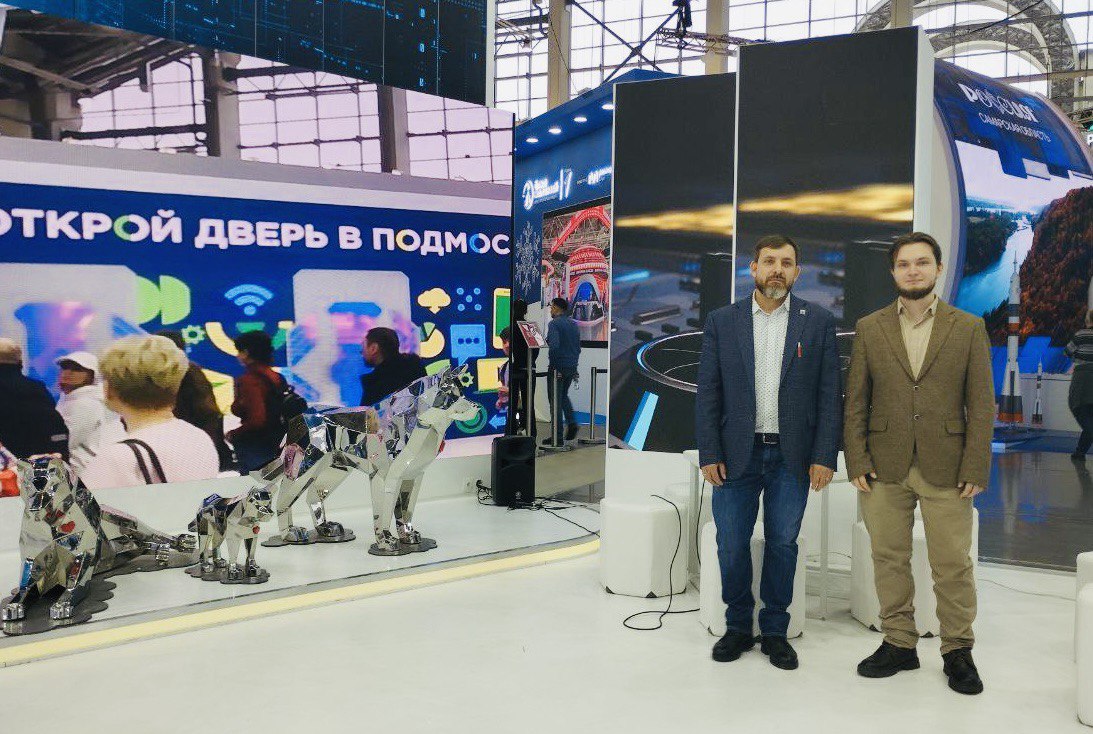
At the exhibition “Russia”, a forum of national achievements “Digital Economy” was held, organized by the Ministry of Digital Development of Russia with the participation of the Autonomous Non-Commercial Organization “Digital Economy”. Government officials and major market companies spoke about the creation and use of modern technologies. Derzhavin University presented an implementation of the general structure of constructing a convolutional neural network (CNN) for designing CNNs in real time.
“I was pleased to represent the Tambov region and my beloved Derzhavin University at the forum dedicated to digital development. The event program is rich in a large number of lectures and interactive activities,” shared the head of Derzhavin University Digital Department, Alexander Skvortsov, “The essence of Derzhavinsky’s development is recognition of faces and emotions by artificial intelligence.”
The technology performs face recognition and emotion classification tasks in a single step using the proposed CNN architecture. Once the details of the setup are presented, the training procedures proceed to evaluation on standard test sets. Validation of the model showed an accuracy of 66% on the FER-2013 emotion classification dataset.
“Along with this, we also present a technique for controlled visualization of backpropagation in real time, which was used to validate the model,” commented Alexander Skvortsov. “Controlled backpropagation reveals the dynamics of weight changes and evaluates the learned characteristics. Careful implementation of modern CNN architectures, use of current regularization techniques, and visualization of previously hidden features are necessary to bridge the gap between slow performance and real-time architectures.”
At the Forum of National Achievements, Deputy Chairman of the Russian Government Dmitry Chernyshenko noted that the need for IT personnel is still high. The number of IT specialties increases every year, and the number of budget places for them in higher educational institutions also increases. In 2023 there were 470 thousand, this year it will increase to half a million. More than 250 thousand schoolchildren and college students study in free programming courses, and 278 thousand students study in “digital departments” at universities. Derzhavin University, as one of the 115 winners of the Priority 2030 program, participates in the joint project of the Ministry of Education and Science and the Ministry of Digital Development “Digital Departments”. By 2023, this made it possible to train more than 1,000 people in digital competencies and have a systemic impact on the development of IT education at the university. IT companies have become full-fledged participants and co-authors of the educational process; students are now learning through real project work in high-tech companies, finding employment in them while still studying.