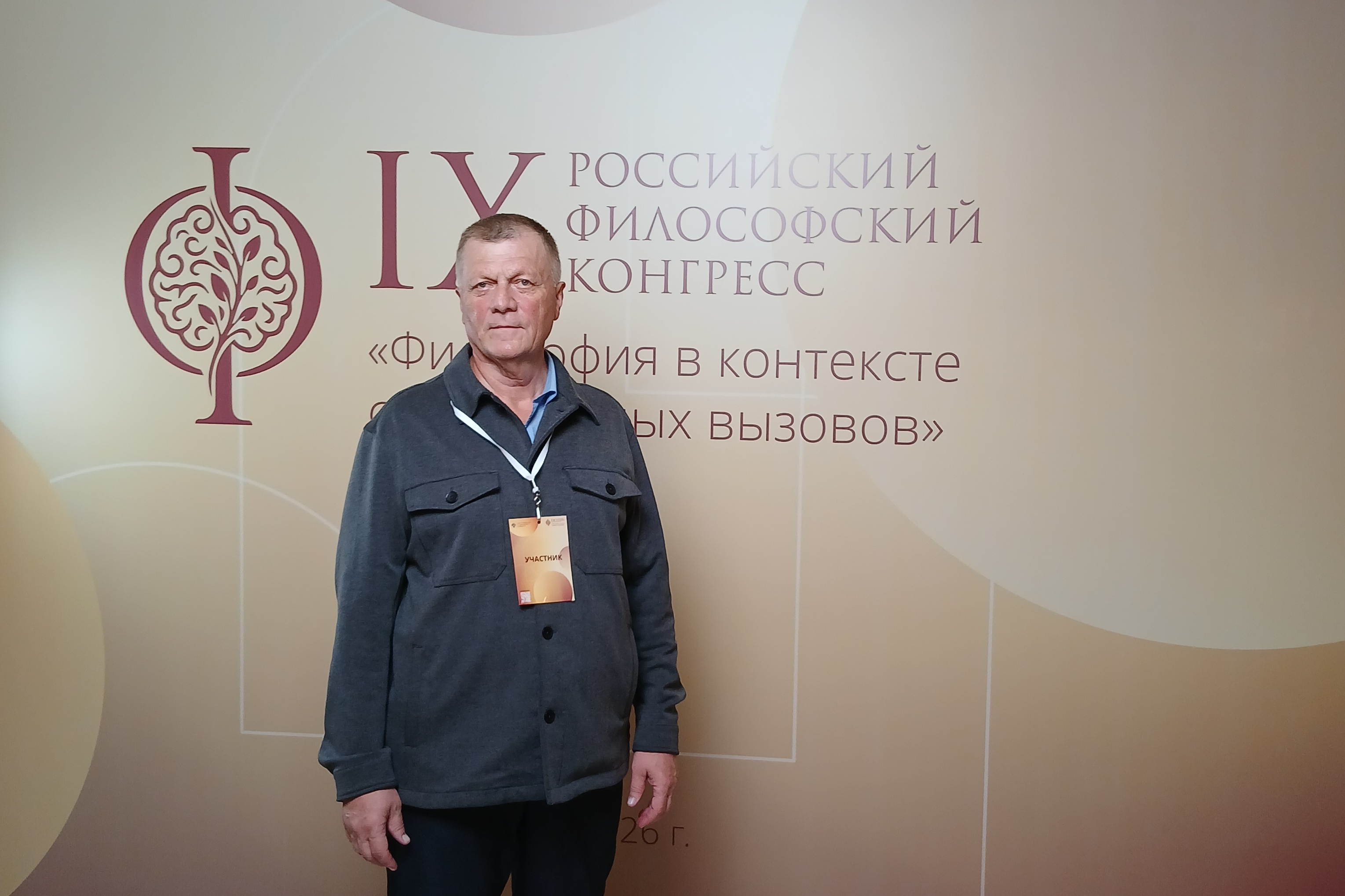
Derzhavin University Professor Nikolai Medvedev participated in the IX Russian Philosophical Congress "Philosophy in the Context of Modern Challenges," held in St. Petersburg.
The large-scale forum brought together over 900 researchers and experts from various regions of Russia, as well as nine foreign countries. Over the course of three days, participants discussed issues of Russia's civilizational identity, the preservation of cultural codes, the role of the humanities, and the development of approaches to understanding contemporary geopolitical and social processes. The congress program included approximately 50 thematic sections, roundtables, and panel discussions on various areas of contemporary philosophy.
In the "History of Foreign Philosophy" section, Derzhavin University Professor Nikolai Medvedev, Doctor of Philosophy, presented a paper entitled "A New Myth or a New Way of Thinking: Wittgenstein's Reception of Freudianism." According to the author, a historical and philosophical analysis of this topic opens up prospects for new, meaningful interpretations of the ideas of the outstanding 20th-century philosopher Ludwig Wittgenstein. This creates the preconditions for the adaptation and application of his philosophical approach in various areas of spiritual culture.
One of the central events was the award ceremony for the Eurasian Philosophy Prize, established in 2023.
The forum also featured the presentation of the textbook "Philosophy," edited by Alexey Kozyrev, Acting Dean of the Faculty of Philosophy at Lomonosov Moscow State University, and Taras Varkhotov, Head of the Department of Philosophy and Methodology of Science. Published by Prometheus, the book was commissioned by the Ministry of Science and Higher Education of the Russian Federation and is recommended for use by university professors. The textbook covers the basic topics of philosophy necessary for studying and teaching general science courses.
"At the philosophy congress, it was stated that teaching philosophy is a priority in the transition to a new model of higher education. Philosophy is part of the unified social and humanities core and is a required subject for all students, regardless of their chosen field or specialization," noted Nikolai Medvedev, professor at Derzhavin University. "In the context of a crisis of values and the dominance of utilitarian approaches, philosophy fulfills a vital humanistic mission. It reminds us that education is not just a service, but a process of continuous personal development and self-education. Philosophy addresses the eternal questions of existence, knowledge, morality, and values, which are the foundation for overcoming the value vacuum."