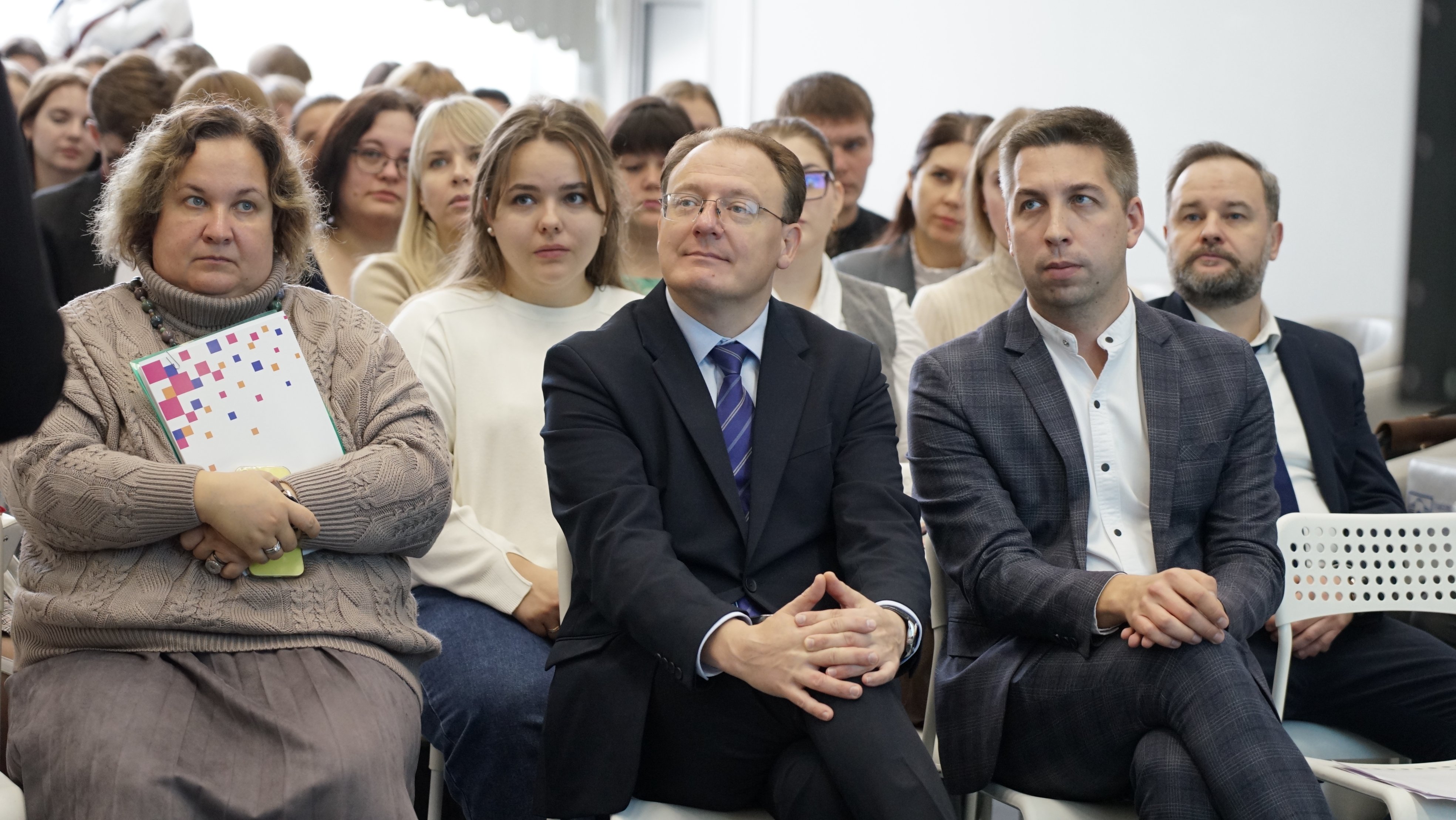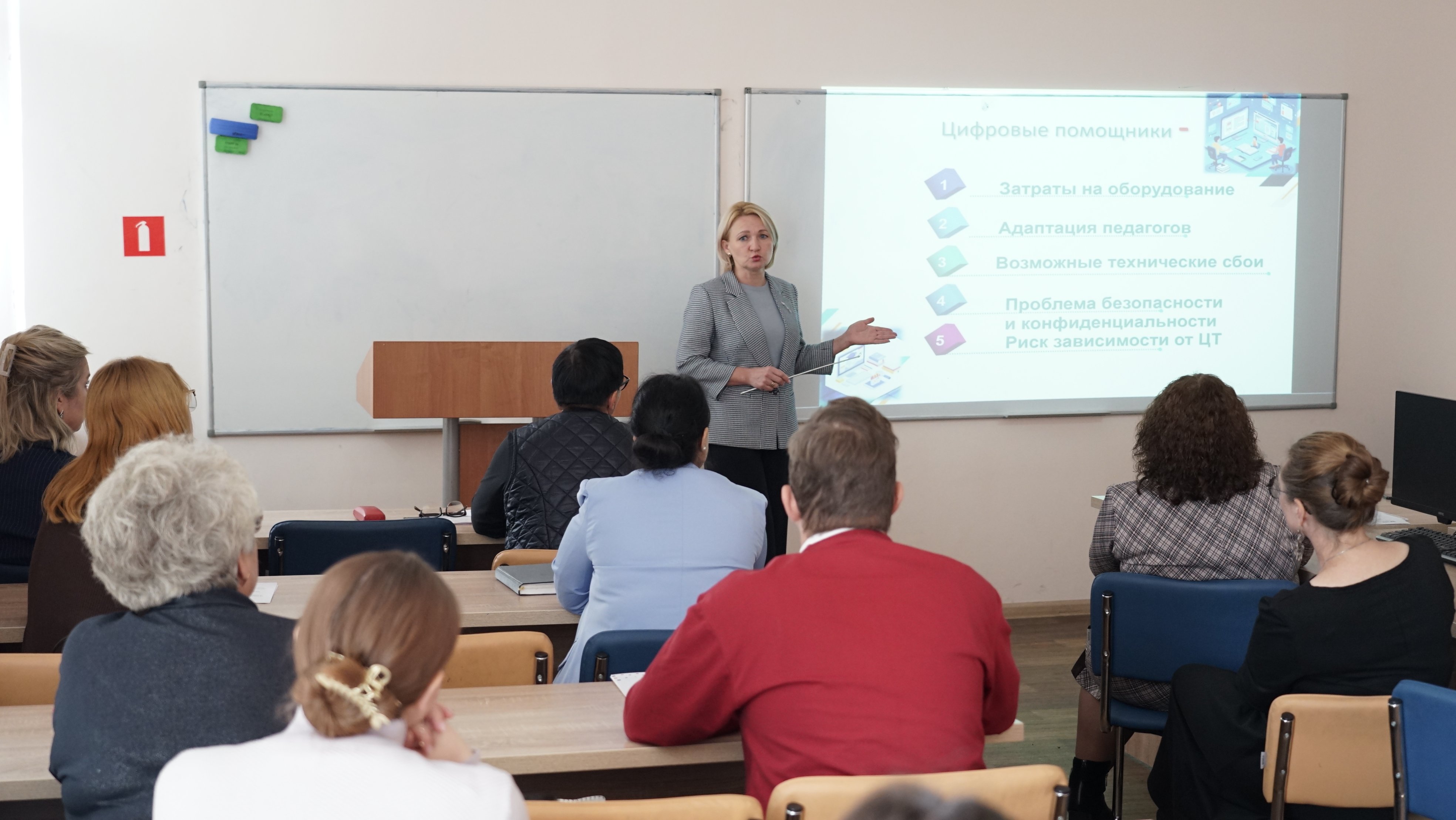
The educational platform "Digital Teacher Workshop: From Artificial Intelligence to Neurotechnology" has opened at the TSU as part of the "School for Young Teachers at Derzhavin’s" project. Over 100 teachers from educational institutions of the Tambov Region, as well as representatives of the Derzhavin faculty, the regional Ministry of Education and Science, and the Institute for Advanced Training of Educational Workers, participated in mastering the new program.
The event aimed to share effective practices, discuss current trends in the digitalization of education, and demonstrate the latest tools for organizing the educational process.
"The 'School for Young Teachers' is an enormous dialogue space. For several years, we have been examining the main development trends of both the educational system and nanotechnology. The teaching community realises that the development of the educational system is impossible without artificial intelligence, neural networks, and augmented and virtual reality. "This isn't a futuristic fantasy, but a today’s reality," said Elena Afonina, Deputy Minister and Head of the Department of Professional Education and Science at the Tambov Region Ministry of Education and Science. "At the educational platform, we will examine how young teachers can navigate the digital space and use these methods in their teaching. Teachers will acquire new competencies and expand their knowledge of digital technologies."
At the plenary session, key vectors for the development of the digital transformation of the education system were outlined.
Nikolai Karev, Vice Rector for Strategic Development at Derzhavin University, delivered a report on "Integration of Modern Information and Communication Technologies and AI-Based Technical Solutions into the Educational Process." In his speech, Nikolai Karev noted that global digital development trends are changing education in Russia. One of the most important areas is the introduction of technology into management of education, where artificial intelligence-based technical solutions are taking over many organizational functions. For example, scheduling classes, generating documents, and conducting analytical work. Online platforms are particularly important, allowing teachers to create, publish, and manage courses, while students gain access to the latest educational materials, complete training, creative, and assessment tasks, and track their personal development trajectory.
During the session, Pavel Sysoev, Doctor of Pedagogical Sciences and Professor at the Tambov Scientific Center of the Russian Academy of Education, presented a report entitled "Personalized Learning Based on Artificial Intelligence Technologies." The professor contemplated on the critical evaluation of the role of artificial intelligence, the necessity to maximize the educational process through digitalization, and the creation of additional conditions for students to develop new competencies while simultaneously developing their basic skills, supported by traditional teaching methods.
The conference continued with a series of pedagogical workshops. The teachers discussed digital didactics, digital pedagogy, online learning methods, media literacy, and neuroeducation. They also discussed modern lesson plans and competencies of a mentor.