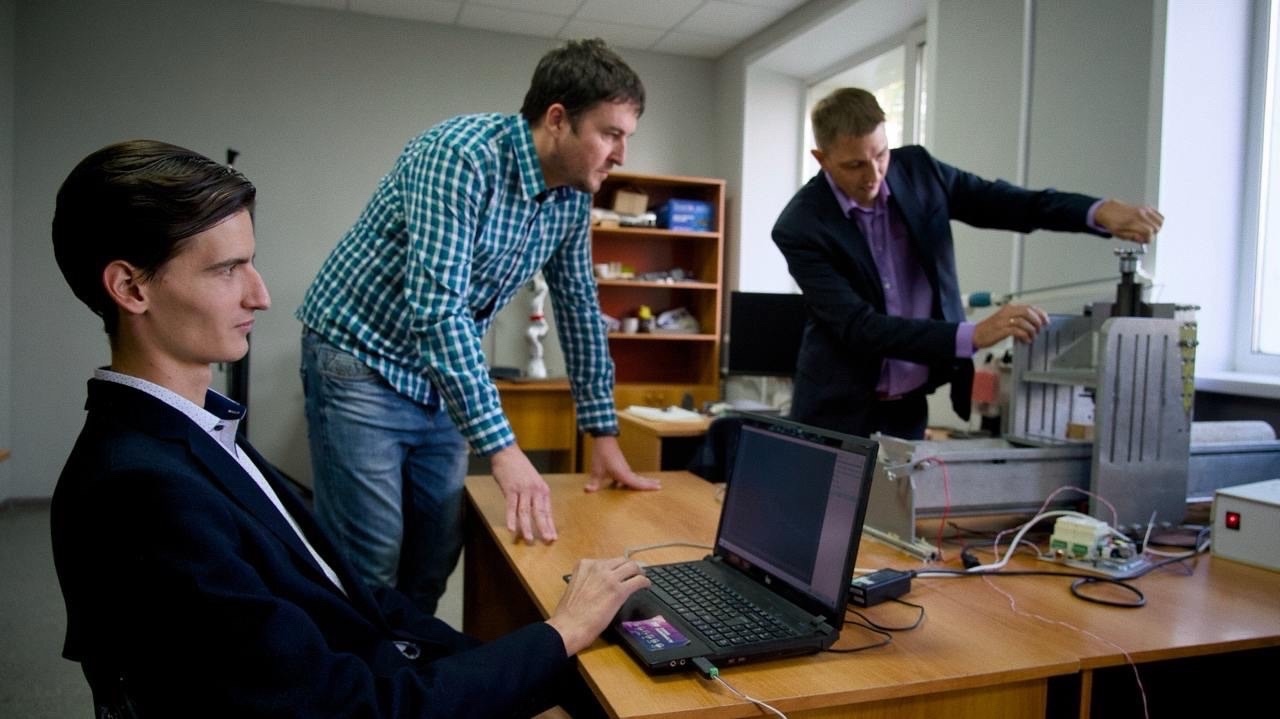
The Department of Strategic Development of the Ministry of Science and Higher Education of the Russian Federation held a commission session to evaluate the achievements of the second phase of the experimental design project "Development of a Universal Installation for Analyzing the Physical and Mechanical Properties of Materials Using Nanoindentation and Digital Scratch Testing" (DST). The work is being carried out by the team of the Scientific and Educational Center "Nanomaterials and Nanotechnologies" of Tambov State University named after G. R. Derzhavin as part of the federal program "Development of Domestic Civil Instrument Engineering for Scientific Research."
Yuri Zakharov, chief designer of the DST project, reported to the commission on the progress of the work according to schedule. Nowadays, approximately 270 sheets of technical documentation have been developed for more than 90 parts of the product, a significant portion of which are of Russian origin. Furthermore, a patent has been obtained for a component of the product. Patent research is currently ongoing, and specialized software is being developed.
The project is being implemented jointly with the Scientific Instrument-Making Consortium, which includes the Moscow Institute of Physics and Technology and other leading Russian scientific institutions. Serial production is planned for PJSC Elektropribor, a Rostec corporation.
The device is designed for the rapid analysis of the mechanical properties of a wide range of materials, including wood, rocks, and construction materials, and will become an important tool for scientific research in university laboratories and domestic industrial enterprises, particularly in the oil, gas, and mining industries. Innovative technologies enable non-destructive testing of materials using scratch testing, significantly reducing costs and preserving valuable samples for further research.
Completion of the project is scheduled for 2026. The result will be a prototype system and complete design documentation, ready for serial production. The new development is expected not only to achieve world-class quality but also to significantly surpass foreign equivalents in cost. The system will be largely comprised of domestically produced components.
In August 2023, the Expert Council for Domestic Civilian Instrumentation under the Ministry of Science and Higher Education of the Russian Federation reviewed over 400 applications from scientists across the country. Following several rounds of review, nine of the best proposals were selected for inclusion in the federal project "Development of Domestic Civilian Instrumentation for Scientific Research." One of these was a proposal from the team at the Nanomaterials and Nanotechnology Research and Education Center of Derzhavin University to develop a universal device for the rapid analysis and characterization of the physical and mechanical properties of composite materials using nanoindentation and precision digital scratch testing.